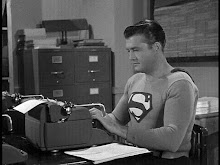
So as many readers will already know, I'm currently working as a background artist in a major movie that is shooting in Philadelphia. I had to sign a confidentiality agreement to work on the film, which is killing my writing habits. They've prohibited us from sharing anything that we're doing on the set, as well as anything that we learn about the design of the film or the plot of the film. I'm taking it very seriously, to the point where I'm not even tempted to say that I'm working on LAB. But put the clues together, maybe click over the link, and you'll see what I'm doing.
I've had some of this week off from work on the film, but I'm heading back for more work starting tomorrow. I've liked having some time off, but I'm ready to start working and making some money again. The constant need to find work is one of the worst aspects of this business. It's a challenge to line things up always looking 3-4 months in advance, trying to line up theatre gig after theatre gig and just string them together. Easily the worst part of acting.
Thursday, April 16, 2009

Friday, April 10, 2009
*Sparking*
Hey everyone, remember that show up in Allentown that I'm working on? You know, the one where we were creating the piece ourselves based on faith and belief? Well, the school had a break and then a trip, so today was the first rehearsal for that project in a while. Since we last all met, we confirmed our performance cast, as well as finalized the rehearsal draft of the script. There might be some minor changes to be made, and I spent an hour or so re-writing one of the scenes that I had worked on months ago. We were racing the clock to finish the rough draft of the script, so the scene never quite came together like I wanted it to. But after talking to another cast member last night, I got a very clear idea as to what the scene needed to be. So I wrote it while everyone was rehearsing, and now that sequence is much stronger.
When I first started working on this show, I was excited to perform in a play that I would help write. But now that I'm not going to be onstage due to my other work, I'm finding a much different excitement in writing a show that others will perform. Much like directing in NYC in January, it's a strange thing. I'm not going to be onstage, but the actors will be speaking my words. It's something new for me, as I've never really written a play before. Sure, I've written movies that I've produced, but it's different to know they are working on this without me there. I have a hand in a film at all stages of work, but this project I'm writing scenes and then turning them over to the director and the actors. I'm very excited to see what they come up with.
When I first started working on this show, I was excited to perform in a play that I would help write. But now that I'm not going to be onstage due to my other work, I'm finding a much different excitement in writing a show that others will perform. Much like directing in NYC in January, it's a strange thing. I'm not going to be onstage, but the actors will be speaking my words. It's something new for me, as I've never really written a play before. Sure, I've written movies that I've produced, but it's different to know they are working on this without me there. I have a hand in a film at all stages of work, but this project I'm writing scenes and then turning them over to the director and the actors. I'm very excited to see what they come up with.
Thursday, April 9, 2009
Story meetings
Last Sunday, I got together with Rob and Markus and we hammered out the entire story arc for the feature version of "The Chrononauts." We had long been working along two different lines for the concept of the feature, and I wasn't sure that we were going to be able to marry those two different ideas into one cohesive plot. But once we all got into the same room, it became pretty easy. I don't want to give away a lot of the details, but we did find a way to combine those two different approaches to the story and yet still find a story that makes sense. It's actually one of the exciting things about working on a movie that involves time travel, we can pull out things that seem to contradict each other and still make them both correct.
We based lot of the ideas on the short film as well. We're not trying to copy scenes or replicate plot points, but we're taking the moments and beats of the short film and just expanding the world that we created. We've got some exciting sequences planned and a nice entrance into the creation of a web-series based on the feature. The film stands alone as an exciting adventure, and yet it also links into a planned larger project. Stay tuned for updates.
We based lot of the ideas on the short film as well. We're not trying to copy scenes or replicate plot points, but we're taking the moments and beats of the short film and just expanding the world that we created. We've got some exciting sequences planned and a nice entrance into the creation of a web-series based on the feature. The film stands alone as an exciting adventure, and yet it also links into a planned larger project. Stay tuned for updates.
Saturday, April 4, 2009
Contract lenses
An actor friend of mine recently accepted an offer to do a summer Shakespeare festival, but she balked at the actual contract they sent her. It had an elaborate confidentiality agreement, as well as certain clauses in the contract that she wasn't sure about. She tried to discuss it with the company, but they told her that no changes could be made to the contract, and she would have to sign it as is. When she was telling me about it, I started thinking about previous contracts I had signed for different companies I had worked for. Most of the time, the contracts were simple one-page documents outlining payment and dates of employment, with almost no more specifics at all. But twice, they were long documents outlining all my responsibilities and expected code of conduct while employed with that theatre.
The first time I got such an elaborate contract, it was a very well-balanced deal, with protection provided for both company and actor in case of a difference between them. By signing it, I promised that I would behave in certain ways and perform certain tasks, but it also guaranteed that the theatre would behave in certain ways and be held to certain standards. It accounted for everything, and I signed it without further negotiation.
The second time I got an elaborate contract, it was much more heavily weighted in favor of the theatre company. I too balked at some of the provisions I was being asked to agree to, and I wanted to change some of the wording in the document as well as negotiate some of its points. I called the company office with a very specific request to discuss the contract. After trying for three days to speak to the correct people, I was eventually told that the changes I wanted were impossible, as they were not company policy. I didn't know if it was company policy to not change the contract, but I was forced to sign it with those less-than-favorable clauses intact. I enventually had a much larger debate with this company over contract matters, but that's an entirely different topic.
How much power do we actors have in these contract negotiations? In reality, the answer is not very much. There are a hundred other actors out there who are more than willing to play the roles that we give up because of contract reasons, and the theatres out there know this. That is one of the chief reasons to have an agent/manager, in my opinion. They can negotiate and discuss the specifics of employment without running the risk of alienating the theatre while they do so. The agent is simply looking out for the best interests of their client, which is something that all actors should be given the freedom to do. We need to learn how to ask for changes, negotiate, and not take "no" for an answer when we think the theatre company manager is just trying to sweep the problems under the rug. By and large, theatre companies do not take advantage of the actors that work for them. But if we run across that rare exception, we should have taken the time and had the courage to re-negotiate a contract that protects us.
The first time I got such an elaborate contract, it was a very well-balanced deal, with protection provided for both company and actor in case of a difference between them. By signing it, I promised that I would behave in certain ways and perform certain tasks, but it also guaranteed that the theatre would behave in certain ways and be held to certain standards. It accounted for everything, and I signed it without further negotiation.
The second time I got an elaborate contract, it was much more heavily weighted in favor of the theatre company. I too balked at some of the provisions I was being asked to agree to, and I wanted to change some of the wording in the document as well as negotiate some of its points. I called the company office with a very specific request to discuss the contract. After trying for three days to speak to the correct people, I was eventually told that the changes I wanted were impossible, as they were not company policy. I didn't know if it was company policy to not change the contract, but I was forced to sign it with those less-than-favorable clauses intact. I enventually had a much larger debate with this company over contract matters, but that's an entirely different topic.
How much power do we actors have in these contract negotiations? In reality, the answer is not very much. There are a hundred other actors out there who are more than willing to play the roles that we give up because of contract reasons, and the theatres out there know this. That is one of the chief reasons to have an agent/manager, in my opinion. They can negotiate and discuss the specifics of employment without running the risk of alienating the theatre while they do so. The agent is simply looking out for the best interests of their client, which is something that all actors should be given the freedom to do. We need to learn how to ask for changes, negotiate, and not take "no" for an answer when we think the theatre company manager is just trying to sweep the problems under the rug. By and large, theatre companies do not take advantage of the actors that work for them. But if we run across that rare exception, we should have taken the time and had the courage to re-negotiate a contract that protects us.
Wednesday, April 1, 2009
Preserving
Rob and I have spent the last two evenings working on cutting his horror film We had done the opening bits of the film a few weeks ago, but over the last two days we tackled the real bread and butter of the movie. The middle of the film has some important exposition in it, setting up some of the characters and the history of the town. But this is already after we've had a high-octane sequence, so the challenge became crafting the calmer scenes to match the energy of the more action-driven scenes. It became about finding the best patter to put into those dialogue-driven scenes. We hit upon the idea of overlapping different lines, crafting a more dynamic and more cohesive performance than the actors actually gave. It makes the scenes stand stronger on their own, and they fit much better into the overall flow of the narrative.
It's always the thing that's the most strange about editing a feature is that the editor can really craft the performance of the actors. The actors give strong performance that fit into the overall scenes. But some actors can not only give performances that fit into the moment of each scene, but also fit into the continuity of the entire film. Otherwise each scene takes on a full life but the overall film lacks flow. That is one of the real marks of a good film actor. Well, that, and an avoidance of something that I'm now calling "actor-time." In real life, we connect each action and movement into a single organic flow, but film actors sometimes give a performance that is a little too disconnected to feel truly "real." Working on this side of the editing deck has given me a secret as to what casting directors see, so I think of it as good on-the-job training.
It's always the thing that's the most strange about editing a feature is that the editor can really craft the performance of the actors. The actors give strong performance that fit into the overall scenes. But some actors can not only give performances that fit into the moment of each scene, but also fit into the continuity of the entire film. Otherwise each scene takes on a full life but the overall film lacks flow. That is one of the real marks of a good film actor. Well, that, and an avoidance of something that I'm now calling "actor-time." In real life, we connect each action and movement into a single organic flow, but film actors sometimes give a performance that is a little too disconnected to feel truly "real." Working on this side of the editing deck has given me a secret as to what casting directors see, so I think of it as good on-the-job training.
Tuesday, March 31, 2009
Mmm.... Brains....
The blog police are after me. I can heard their boot'd tread on the stairway now; their fists will crash on the door, push it open, manhandle me to sit in front of my laptop and type, TYPE!, to put something new out into the interwebs. So before they have the chance to knock down the door and ruffle my t-shirt, I'll write.
Last Friday night marked the second performance of the Mmmm....Brains.... new play festival downtown. All zombie themed plays. What's not to like? My last entry was about the fun I had with the cast, and that spirit of playfulness lasted for the process. We had a performance two Fridays ago, which went very well. After that first showing, the playwrights were given the chance to make changes and re-writes to their work. Alex decided not to do another draft, so we worked on making the second performance more of a fully realized event. The first one didn't have costumes, and we only mimed the food props called for in the script. For the second show, we wanted to give a fuller look to the play by using costumes, makeup, and, yes, real food.
The script says that my character puts out a tray with two different kinds of crackers and a bowl of dip. Though the course of the show, I feed it to the other characters with my bare hands, and then the other couple roll around on the ground, covering themselves affectionately in dip and crackers. It took us a few tries to find the right prop to use as the edible dip - hummus was rejected when one of our company didn't like it at all. French onion dip made half of us sick - it tastes great combined with potato chips and veggies, but not on its own. At the show, our director brought a container of tapioca pudding, which worked perfectly. And it got everywhere. Nice.
The entire project was a blast from beginning to end. I always love working on new plays and new scripts, especially short plays about zombies. I also felt really lucky to meet all the folk who were in the company with me. Very cool people all, and people that I want to work with again in the future if I get the opportunity. One of them is involved in film festivals (the subject of a-still-upcoming blog entry), and so they are good people to know for my career.
But above all, it was a blast. Working in theatre is supposed to be fun, and this whole process was a very fun one. I hope to do something like it again soon.
Last Friday night marked the second performance of the Mmmm....Brains.... new play festival downtown. All zombie themed plays. What's not to like? My last entry was about the fun I had with the cast, and that spirit of playfulness lasted for the process. We had a performance two Fridays ago, which went very well. After that first showing, the playwrights were given the chance to make changes and re-writes to their work. Alex decided not to do another draft, so we worked on making the second performance more of a fully realized event. The first one didn't have costumes, and we only mimed the food props called for in the script. For the second show, we wanted to give a fuller look to the play by using costumes, makeup, and, yes, real food.
The script says that my character puts out a tray with two different kinds of crackers and a bowl of dip. Though the course of the show, I feed it to the other characters with my bare hands, and then the other couple roll around on the ground, covering themselves affectionately in dip and crackers. It took us a few tries to find the right prop to use as the edible dip - hummus was rejected when one of our company didn't like it at all. French onion dip made half of us sick - it tastes great combined with potato chips and veggies, but not on its own. At the show, our director brought a container of tapioca pudding, which worked perfectly. And it got everywhere. Nice.
The entire project was a blast from beginning to end. I always love working on new plays and new scripts, especially short plays about zombies. I also felt really lucky to meet all the folk who were in the company with me. Very cool people all, and people that I want to work with again in the future if I get the opportunity. One of them is involved in film festivals (the subject of a-still-upcoming blog entry), and so they are good people to know for my career.
But above all, it was a blast. Working in theatre is supposed to be fun, and this whole process was a very fun one. I hope to do something like it again soon.
Tuesday, March 24, 2009
Homeward Bound
One of the crazy and fun things about this life is that I am now back on the bus, headed home to Philadelphia after my NYC audition this morning. Sure, we're still in NYC downtown traffic, but we're on our way. The audition went very well. I did my monologue, and then I read one of the opening scenes of the play with the girl who was there to be a reader. I did the scene once, the director gave me some feedback, and then I did the scene again taking his notes. He was nodding and smiling as he watched me work, which I always take as a good sign when I get it. Then he complimented my work and the change I made to the scene (definitely a good sign), and we briefly chatted about the logistics of the rehearsal and performance schedule. But I nailed the audition. Again, like I say after all of these auditions, nailing it doesn't mean I'm going to get the part. This time around I was recommended to the director by a mutual friend, so it's great to make a good impression for both of our sakes. Plus, he's a very well-known and respected director in the New York theatre community, which is always a good contact to have. And more importantly, is always a good contact to have given a stellar audition for.
Also, this is my 300th post to this blog according to Blogger. Happy Anniversary to me. I guess this means that I'll have to start printing out the earlier pages from my time at Bristol Valley or my various shows with TNT over the years, and I'll be collecting them into a book copy of the blog. Some comments will be presented just as they are online, with bonus pictures and perhaps footnotes. Or endnotes. No, footnotes. Endnotes piss me off with the constant turning of pages. I'll call it the 300th post special edition, signed copies will be available. Look for it on Amazon!
Also, this is my 300th post to this blog according to Blogger. Happy Anniversary to me. I guess this means that I'll have to start printing out the earlier pages from my time at Bristol Valley or my various shows with TNT over the years, and I'll be collecting them into a book copy of the blog. Some comments will be presented just as they are online, with bonus pictures and perhaps footnotes. Or endnotes. No, footnotes. Endnotes piss me off with the constant turning of pages. I'll call it the 300th post special edition, signed copies will be available. Look for it on Amazon!
Subscribe to:
Posts (Atom)